Monday, September 9, 2013

Guess who's trapped in Zamboanga? Witnesses vs Napoles WHAT A COINCIDENCE???


MANILA, Philippines - The ongoing firefight between military forces and Moro rebels in Zamboanga City has affected even the quest for justice in the pork barrel scam, as witnesses against Janet Lim-Napoles were among those unable to fly out of Zamboanga airport to Manila.

The witnesses were supposed to jointly swear and affirm before the National Bureau of Investigation (NBI) their affidavits against the alleged scam on Monday. However, this will no longer push through because some of the witnesses supposedly fying from Zamboanga have been trapped in the firefight in the city. 
"Several witnesses are from Zamboanga, but the flights have been cancelled and they can no longer go to the NBI in Manila," lawyer Levito Baligod, counsel for the witnesses, told InterAksyon.com in a phone interview Monday morning. 

Philippine Airlines (PAL) on Monday cancelled all its flights in and out of Zamboanga "to ensure the safety of its passengers amid the ongoing security concerns in the city."
The city has shut down following the attack early Monday morning, initially attributed to the Moro National Liberation Front (MNLF) of Nur Misuari. 
In its advisory, PAL said the cancelled PAL Express flights are Manila-Zamboanga-Manila scheduled for tonight and flights bound for Jolo, Davao, and Cebu.
 

By: InterAksyon.com

Ten Golden Rules for Forex Traders

1. Learn the market. There are many ways to learn Forex trading technique. A great learning method is to explore the internet for great substantial material and Forex forums. There are many great websites and tools across the internet that teach Forex Trading. Additionally, many Forex companies offer learning courses; enrolling in a session is a great way to learn from the pros. 

2. Start trading with a Demo Account! Most trade platforms provide the option to create a Demo Account as a way for new clients to practice trade. Demo Accounts are a great to get to know your trading platform and build your own trading strategy before you trade. This will also provide the highest value discipline. 

3. Choose a reliable broker firm with low spreads and low costs. Before you deposit money into an account, remember, the money you are trading with should be money you can afford to lose.

4. Start by depositing a small amount. Initially only deposit somewhere between $500 to $1000. Before adding to your account, ensure everything is okay and working properly, considering your broker and your strategy.

5. Always deal with Stop Loss. Before entering a transaction, know how much you're willing to risk in order to gain. Additionally your trade should be no more than 3%-5% from your portfolio.

6. Do not trade a transaction with an unclear direction. Since it is a dangerous market, always remember a good technical analysis wins not by emotion. 

7. Leverage is a very powerful tool for tradesman. The forex market allows you to leverage up to 1:500. Learn to leverage wisely. If not used correctly, it can be a guaranteed way to lose money very quickly.

8. Analyze the Market. Use tools to analyze the market; this will insure future transactions. Try to predict the market trend identitfying support and resistance points. Market analysis is necessary for successful trading. 

9. Learn to accept the Forex Market is uncertain. As noted above, trade is unpredictable; it is not guaranteed predictions will be correct throughout the trade. This uncertainty however is also the key that leads to significant gains in forex trading. The quicker you understand to live with the uncertainty, the more successful you can be in trades.

10. Restrict your daily loss. Never reach a point of completely emptying your account; this will disable your account as you will not have enough margin to open trades. Therefore, restrict your daily loss. If you reach a point of significant loss, it is advisable to turn off your computer and return tomorrow; remember: each day is a new day with new opportunities to gain money.

Credit: Sunbirdfx

Sunday, September 8, 2013

US Week Ahead: PPI, Retail Sales, UMich Svy

Both the top-line and core PPI likely rose 0.1% in August.
Residential gasoline prices moved lower between the July and August reference periods and seasonal factors will only slightly offset this, resulting in a softer energy index for the month. Food prices were unchanged last month and agricultural prices, measured by prices received by farmers, declined in August suggesting that food prices in the PPI should be flat or negative. Price pressures in the core should also be limited in line with information in the Fed’s most recent Beige Book, which indicated that many districts saw “modest growth, no change, or slight decreases in overall commodity and input prices.”
We forecast a 0.6% increase in August retail sales on robust auto sales, while retail sales excluding autos likely rose a more moderate 0.3%
Motor vehicle sales came in at a strong 16.0 million unit annual rate in August, up 1.8% from July and up 11.1% from August 2013. Robust auto sales should add significantly to the top line retail sales figures. In retail sales excluding motor vehicles, we look for a more moderate 0.3% gain. Some reports have suggested that back-to-school sales contributed to sales gains at the end of August, but the Fed’s recent Beige Book reported mixed activity in different regions of the country. The Philadelphia Fed district, for instance, noted that “consumers engaged in ‘price-shopping’” and that “consumers [remained] cautious with their purchases and highly price-sensitive.” Overall, information on consumer activity points to a moderate pace of spending growth during August.
We expect that the preliminary September University of Michigan Consumer Sentiment was roughly unchanged at 82.0.
Since the release of the final August figure equity prices have moved slightly higher, and gas prices have moved slightly lower, which should be positive for sentiment. The survey period coincides with the debate over US involvement in the Syrian conflict, which may present a downside risk to our forecast if it negatively impacts consumer sentiment.

Credit: Michael Carey, N. America Chief Economist  
Crédit Agricole via eFXnews


7 of the most common investment mistakes

There is no computer program or individual that will make all the right investing decisions all of the time. Here are the some common mistakes investors make.

In life, mistakes happen. The same is true in investing. With all of the historical data and experience we possess there is still no computer program or individual that will get it right all of the time. This is because investing contains uncertainty. Moreover, investing is an emotional endeavor, especially when the money was the product of years and years of hard work and discipline. In this article, we'll examine some common mistakes investors make.

Mistake No. 1: Making emotional decisions

It's true that investing is part science and part art. Because of this, generally speaking, successful investing should contain elements of each. Decisions made purely by emotion can bring disastrous results, just as decisions made only from a computer program can also pose a problem. Emotional decisions are often tainted with biases. For example, when investors buy a particular investment and it subsequently rises, they may adopt the belief that they were sure that would happen. Conversely, if the investment declines, they may convince themselves that they had a hunch that could happen as well.
This inconsistency is because human behavior has a tendency to arrange our thoughts to fit the thesis of the moment. This is where 'behavioral finance' enters the picture. Psychologists have identified a number of human biases which explain certain inconsistent patterns of behavior. The truth is, good investment decisions contain elements of number crunching as well as human reasoning. And, although it's important to recognize this, it's much easier said than done. Now, let's move on to mistake #2, holding a losing investment too long.

Mistake No. 2: Hold a loser until It breaks even

I've seen this a number of times over the years. The storyline goes something like this. I bought an investment and it lost value. Now it is down 20%. But when I bought it, I believed it was a good investment. Therefore, I'm pretty sure it will rebound and when it breaks even I'll sell it. The truth is they will probably not follow through. Why? Because, if and when it comes back, they'll hold it, believing it will continue to rise, reinforcing their initial belief that it was a good investment decision. Here's the problem. 
If the individual were to sell it at a loss they would be forced to admit that they made a bad decision. And admitting this is very difficult for some. In reality, sometimes it's best to cut your losses and move on. Now let's look at mistake #3, impatience.

Mistake No. 3: Impatience

Investing requires a great deal of patience. Conversely, making rash decisions, in any endeavor, can be problematic. Most of us have been trained by society to expect "instant gratification." The truth is, life doesn't work that way and neither does investing. Investing requires patience. For example, there are numerous instances where an investment severely lagged for several years before it turned around and became a top performer.
This is not at all unusual. Therefore, assuming you have chosen a quality investment, to maximize its return you need to be prepared to hold it through a complete cycle to allow the manager's strategy to play itself out. How long is a complete cycle? This can only be answered after the fact. It's the same with identifying the end of a recession. It's normally several months after the fact before we realize a recession has actually ended.

Mistake No. 4: Placing too much importance on past returns

When selecting an investment, don't rely solely on past returns. For example, if you're buying a mutual fund it's important to evaluate how the manager performed during a bad period in the markets, such as 2008. My clients, on average, lost 16.25% that year.
There were a number of reasons why it wasn't worse, but here's the point. When you look at a mutual fund's performance during a bad year, if you find they lost markedly less than similar funds, it may be an indication that they have strong risk management controls in place. The importance of this cannot be overstated, especially when the next downturn occurs.

Mistake No. 5: Avoid water cooler recommendations

Just because a friend recommends a particular investment it does not necessarily mean it's a good choice. Moreover, there are some important issues to consider. Here's how a typical conversation unfolds. A friend tells you about this great mutual fund they own (never mind the ones that didn't work out). "In fact," they say, "last year it returned X%!" "Wow," you reply. "That's more than I got!" Perhaps it really did do well. But here's the relevant question. Will its performance be replicated?
In other words, will the following year be as good as the previous year? Odds are not in your favor on that one. In fact, if you make your decision based solely on past returns, you stand a good chance of being disappointed. There are a number of important statistics to consider when investing, but past returns have very little to do with future returns. And, funds that were at the top of their peer group one year, often do not remain there the following year.

Mistake No. 6: Failure to harvest winnings

The saying "Nothing goes up forever and nothing goes down forever" is highly applicable to investments. With human nature as it is, most would tend to sell the losers and invest the proceeds in the winners. However, this would usually be the wrong decision. When you have a position which has risen and now has a substantial gain, it's usually best to harvest some of its gains. I say "usually" because there are a few exceptions to this, but we don't have the time to elaborate. Suffice it to say that emotion would dictate that we keep the winners and sell the losers. But try to resist this urge. Which brings us to the next mistake, getting in too late.

Mistake No. 7: Investing near the top

When investors suffer a major loss, as many did in 2008, fear spikes and they tend to sell their losers and wait on the sideline until they feel it's safe to get back in. However, by the time they feel it's safe to invest in stocks again, it's usually after stocks have risen substantially. Even though we all recognize it's best to invest when prices are low, because fear peaks after a major decline, most individuals are hesitant to reenter the market after a severe selloff. This is another mistake governed by emotion. To avoid this, it's best to have rules in place that dictate when you will buy and when you will sell. In other words, to the extent you can remove emotion from the equation, your chances of investment success will rise, assuming your rules are sound of course.
Obviously, there are additional mistakes. In fact, we could probably go on and on, but these are some of the more common errors investors make. To reduce your mistakes remember, be patient and even though it goes against how you may feel at a given moment, try to adopt a contrarian point of view. In other words, don't follow the crowd.
Because emotional investing can be so damaging, a very large percentage of wealthy and affluent individuals delegate this task to a qualified advisor. This is one way to remove some of the emotion from the equation
Credit: Mike Patton, Forbes

Saturday, September 7, 2013

20 Habits That Will Make You A Success

1. Don’t define success with a dollar amount, but in relation to your happiness.

The habit of defining success with a dollar amount will lead you to constantly chasing a higher price point. It’s a chase that will never end, and a view of success that will never be attained. Get in the habit of seeing your success and your happiness in the same light.

2. Read before you write or work.

Reading a good book will get the creative juices flowing, the brain learning, and your knowledge base growing. Try reading for 30 minutes to start your day.

3. Wake up at the same time everyday.

Having a good sleep routine will help you have more energy to do more work during the day.

4. Always finish your to do list.

Get in the habit of never leaving anything that you wanted to finish at the beginning of the day, incomplete at the end. If you simply do what you set out to do, it will be hard for success to elude you.

5. Keep your to do list small and scaled.

Have 1 or 2 things that are important to finish, and make sure you finish them first. The rest of your tasks should be tended to only after your most important ones have been completed.

6. Keep two journals; one for your planning, scheduling, and work.

The other for your big ideas, thoughts, and goals. Writing stuff down makes it real and tangible. A to do list, a goal, or a dream, that isn’t written down isn’t yet real.

7. Measure everything.

Every goal you set needs to be measured. Every sales page you create, needs to be measured. If you measure everything you’ll have a blueprint for exactly what does work, and what doesn’t.

8. Stick to 90-minute work sessions.

Few people actually work as much as they say they work. Their time is usually made up of distractions. They Facebook, Tweet, and surf the interwebz. Time your work sessions. Keep a stopwatch. Focus for 90-minutes, take an active break, then get back to the beautiful grind.

9. Take active breaks.

A work break should enhance your working experience. It can’t – at all costs – take away from it. So do something active that will get your blood pumping and your mind working as effectively as it was when you first started working in the wee hours of the morning.

10. Wake up early.

The list of successful people who wake up before the rest of the world is far too long to list. This isn’t a coincidence. Get up before 6 am, 7 days a week and get a head start on your day and your dream.

11. Put your family first.

Success can’t exist without family – even if that “family” is simply loved ones and friends. You need to be working for a greater purpose than your own monitory gain if you’re going to accomplish truesuccess.

12. Work harder than your competition.

If you work harder than everyone else, success can’t hide from you. You will find it. And you willenjoy it.

13. Use a board.

Use a big white board to keep your goals visible and close.

14. Share your dream.

Get in the habit of talking to others who have a similar dream, even if the similarity is the enormity of your goals, and the audaciousness of your plans. Napoleon Hill coined this relationship “a mastermind”, and it’s one of the most important factors in your eventual success.

15. Only surround yourself with successful people.

That is, don’t have “suckers” in your midst – people who will tear you away from your work, and destroy your dream. If you have friends that do this, stop hanging out with them. Are they worth you living a mediocre life when greatness can be in your future?

16. Keep a healthy body.

Without a healthy body it becomes evermore difficult to maintain a healthy mind.

17. Spend your money only on things that will propel your dream.

Cars, “things”, are only good for boosting your image in an effort to impress people who you really don’t want to impress. Spend money, instead, on your own development and your business to fuel your growth.

18. Make a sacrifice.

Get in the habit of sacrificing things that you may like in your life, for things that will help you become a success. The road to greatness isn’t one of excess spending and easy living. Hustle. Focus. Sacrifice. Succeed.

19. Review your journals every month.

A journal can bring you clarity when you write in it, but it’s far more powerful when you get in the habit of reviewing it.

20. Write down 3 things you’re thankful for every day.

What you’ll find is that success is often in your midst if you look at it from the right perspective. And study after study has shown that happy people achieve far greater things than pessimistic, unhappy individuals. This habit, combined with hard work, is as simple a recipe for success as you can create. It’s also an effective one.

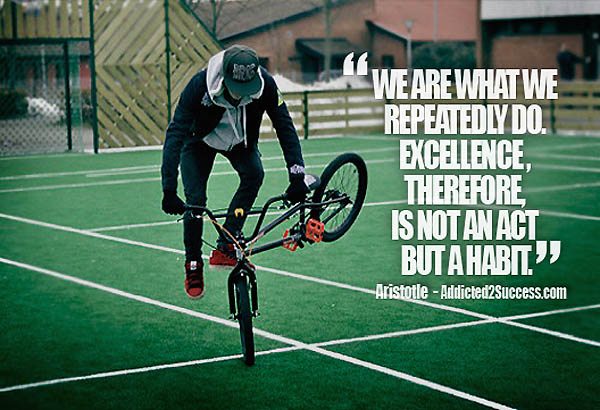
Aristotle-Inspirational-Picture-Quote

If your habits are those of a successful, happy, productive, hard-working person, there’s no way that you can’t be successful. Make your success unavoidable by changing your habits.

Credits: Chad howse

Friday, September 6, 2013

Trading During the US Non-Farm Payrolls

Indicator Background

Job creation is one of the most important leading indicators of overall economic activity. The release of US Non-Farm Employment Change is highly anticipated by the markets, and an unexpected reading could affect the direction of all USD pairs.

Non-Farm Employment Change dropped sharply from 195 thousand in July to just 162 thousand in August. This was well below the estimate of 184 thousand. The markets are expecting a substantial improvement in the upcoming release, with an estimate of 177 thousand. Will the indicator meet or beat this prediction?

Are you guys trade ? :D

How to Make a Million Dollars!


No cheesy suite or hoodie needed:


Supplies:
A Google doc/Excel sheet (What’s come over me?)
Song: Million Bucks by Maino on Spotify

Pick my income? Who does that? Isn’t salary something you grovel for with manipulative tactics? This is the plan I’m currently using that makes me want to get out of bed in the morning. No, I’m not a millionaire, YET. I’m not playing at Sir Richard Branson or even a finance specialist.I went to art school. I do know that years of business classes and working for Internet marketing gurus made me want to poke my own eye out with a pencil.
First we’re going to talk about cash in a “take what’s yours,” attitude. If you’re going to get uncomfortable click the X on the top right corner. I came from a house where talking about money in a positive sense never happened. I used to hide from my Father when the credit card bills came.
This changes all of the panic mentality around money.None of this is rocket science and I have no idea why people don’t do this. If it’s not fun you’re doing it wrong.
  1. Select your ten top interests. These go in the top row of your Excel sheet. I don’t care if you’re flipping burgers right now or cleaning bathroooms. This is for you. I don’t care if you’re fending off a case of the blues because somebody left you in the park. You have ten different interests. My interests that I listed are (photography, design, marketing, public relations, writing, fitness, travel, fashion, event planning, and theater). I also have a column for non-profit work and random things that didn’t make sense in the other categories.
  2. Each interest becomes a profit category. Put each interest as a column header. You are going to bank $100,000 in each of your own interests. Being a New Yorker, I never believe people when they go dropping numbers like they’re tacos. How are you going to get to $100,000?
  3. Pick 10 projects for each category. This may take a bit of brainstorming but if you’re into everything from construction to body building you can get to $10,000. I know you can get to $10,000 by designing five websites or photographing five weddings. Most likely, you’ll totally outgrow that $10,000 benchmark.
  4. Did you just suggest that I open 100 businesses? Not all at once, clearly. If you have enough projects going you’ll see momentum somewhere.
  5. I’m sure someone is thinking, “What if one of these things fail?” You have 99 other things in your Excel sheet. Go do those.
  6. I always encounter people who feel like a business must have huge costs to get started. Trying to meet just the $10,000 benchmark insures you won’t go to crazy trying to open a theme park (yet).
  7. A list of 100 ideas to execute may freak you out if you see yourself as “just an illustrator.” I think it’s okay to develop a wider definition for ourselves. Fear of failure makes us come up with things like, “never a corporate sellout,” or “too down to earth want something like that.” Also, what’s cooler? A broke illustrator or one with ten projects in the mix? That they picked. In the words of Seth Godin, “pick yourself.”
  8. Have fun with this. Some ideas won’t seem like a full time calling like running a film festival in your neighborhood. Except, that’s the kind of fun thing a girl could do for the rest of her life.
  9. If you’re philanthropic you still have to brainstorm ways to make a profit. That’s a topic for another piece but wanting to help people is not an excuse to starve. If you’re selling the tickets to that concert for charity make sure you get paid. You’re going to learn to write yourself a check for helping people.
  10. Share these with friends. You have someone in your life who will take interest in your personal training business, retreat to Bali, and bike tours.
  11. Share your spreadsheets with me! I love seeing these.

“Million dollar ideas are a dime a dozen. The determination to see the idea through is what’s priceless.” - Robert Dieffenbach

Credits: Medium.com